

Vital 110™ · for employers
A Benefit Your People Actually Use.
Most of your team has coverage they cannot afford to touch. Vital 110 sits on top of your major medical and gives them care with no deductible to meet first — including in-person urgent care.
The problem you are already paying for
Your Plan Is Working. Your People Still Cannot Use It.
You buy coverage every year. Then a deductible stands between your employee and a doctor, so they wait — and what could have been a $40 problem becomes a claim on your plan.
None of those numbers move because you shopped harder. They move when people get seen early — which is the one thing a high deductible is designed to prevent.
What it is
An Overlay, Not a Replacement.
Vital 110 is an employer-sponsored supplemental plan on a self-funded MEC chassis, offered through your Section 125 cafeteria plan. It does not replace your major medical. It removes the reason people avoid using it.
The part people miss
This One Has In-Person Care.
Employees have been offered telehealth before and did not use it. Vital 110 is not that — the in-person half is the half that changes behaviour.
In person, at a clinic
- Urgent care with no copay — three visits a year, PHCS network
- Preventive screenings, in person
- Lab draws at any LabCorp or Quest, coordinated for them
From their phone
- Doctors and behavioral health, unlimited, no copay
- Prescriptions filled at 80,000+ pharmacies
- A ~55-second facial scan reading 14 vitals
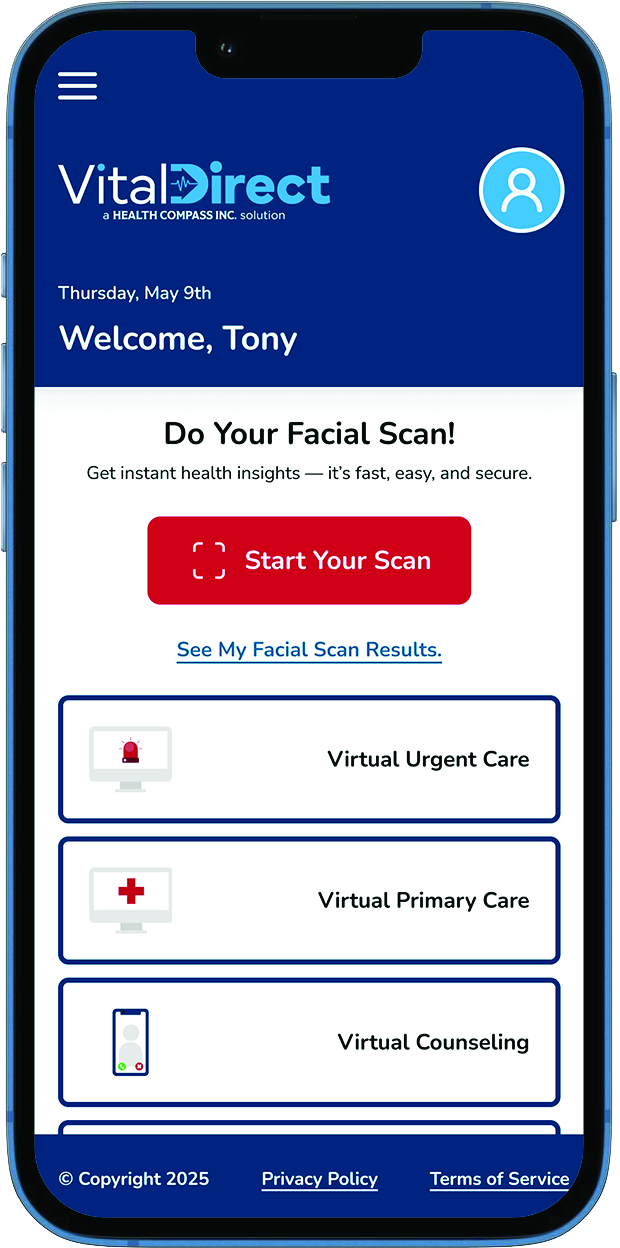
Take a Selfie...Stay Healthy!
A ~55-second selfie video reads 14 vitals — heart rate, blood pressure, stress and more. Employees complete a scan a minimum of once per pay period, monitored by Health Compass. That cadence is a plan requirement, not a nudge.
You have seen this pitch before
This Is Not a “Wellness Plan That Pays for Itself.”
If a plan promising employer savings and higher take-home pay has ever hit your inbox, you were right to be skeptical. We raise the comparison ourselves, because the honest answer is the entire point.
Those are sold as WIMPER and SIMRP programs. In IRS CCA 202323006 the IRS addressed them directly: flat cash paid to an employee who has no unreimbursed medical expense is taxable wages. That memo is why the category is radioactive — and why Vital 110 is built on a different chassis.
| Structural element | Typical WIMPER / SIMRP | Vital 110 |
|---|---|---|
| What is underneath | A wellness program with no health plan chassis | A self-funded MEC plan — ACA-qualifying Minimum Essential Coverage |
| How money reaches the employee | Flat cash per activity, paid regardless of any medical expense | Claims adjudicated by a TPA and documented on an EOB |
| Connection to actual care | None — the payment is the product | Tied to covered encounters and the required scan protocol |
| Plan governance | Often none; promoter-administered | Self-insured design under the ERISA/DOL framework, §125 structure |
| Participation | Optional checkbox nobody verifies | A plan requirement — scans each pay period, monitored |
This reflects Health Compass Inc.’s design basis for Vital 110. It is not a legal or tax opinion, which is exactly why we invite your advisors to check it before you enroll.
Ask us these. Ask everyone these.
Five Questions for Anyone Pitching Payroll-Tax Savings.
Including us — make whoever is pitching you answer these in writing.
Every one of these has a right answer. Ours are below.
- Is there a real plan underneath?
An ACA-qualifying MEC health plan — or just a wellness program? - Are payments adjudicated as claims?
Documented on an EOB — or flat cash per activity? - Is every payment tied to actual care?
A covered medical encounter — or paid regardless? - Is participation monitored?
A plan requirement someone checks — or an honor-system checkbox? - Will they put it in writing before you enroll?
And welcome your CPA’s review? Question five costs a legitimate plan nothing.
Our answer to all five is yes, and the compliance research is yours to hand your advisors. Read the design basis →
The number, stated honestly
What It Does to Your Payroll Taxes.
Vital 110 runs under your Section 125 cafeteria plan, so premiums come out of pay before tax and taxable payroll drops. That is plan design — not a government credit program.
Illustrative only, and dependent on your plan design and your own facts. Confirm every figure with your tax advisor before you enroll. No tax outcome is guaranteed.
Every seat has a different question
Pick Yours.
The owner wants the P&L. The CFO wants the math. HR wants the rollout. Counsel wants the structure.
The P&L case →
See the numbers →
The rollout →
The compliance path →
Next step
Thirty Minutes, and You Will Know.
A short call: what your people actually use today, what this changes, and what your advisors should look at. No obligation and no pressure.